
June 4, 2026 — Maverick Pools
It’s the first question almost every homeowner asks — and it’s also the hardest to answer without knowing your specific project. Pool pricing in Treasure Valley depends on a number of variables that make general estimates largely meaningless. That said, there are real factors we can walk through so you understand what actually drives cost and can budget intelligently.
A custom gunite pool is a permanent piece of infrastructure. You’re not buying a product off a lot — you’re commissioning construction that involves excavation, structural engineering, concrete work, plumbing, electrical, tile, coping, decking, and mechanical equipment. Every one of those categories has a range, and your choices across all of them stack.
The compressed Idaho build window adds its own pressure. Our construction season runs roughly May through October. That constraint concentrates demand, affects subcontractor scheduling, and means projects that miss the spring start window often can’t break ground until the following year.
Size and depth. A larger pool requires more excavation, more steel, more gunite, more plumbing, and more decking. Depth matters too — a pool designed for diving versus one designed for wading have different structural requirements.
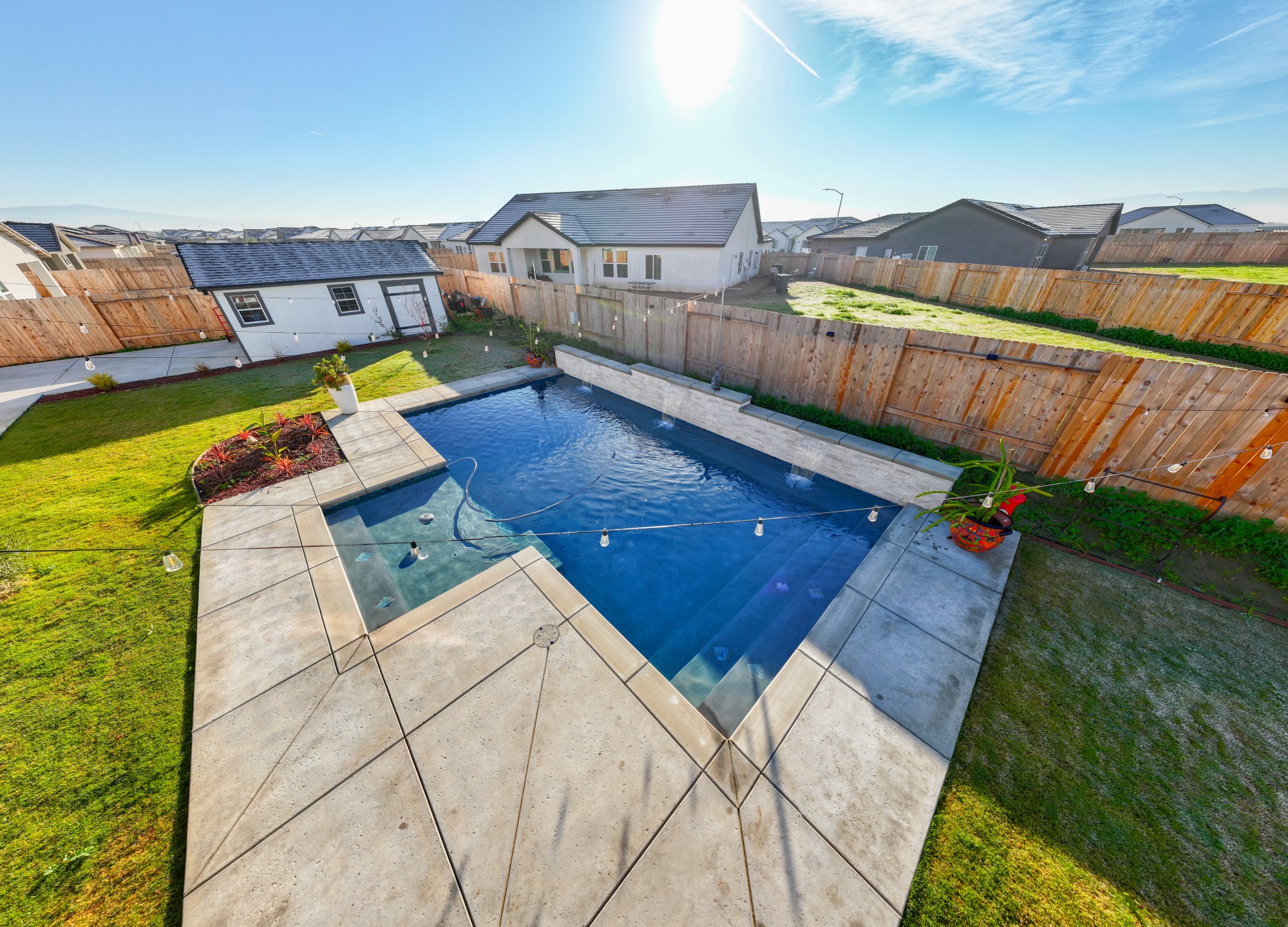
Spa addition. Adding a spa — whether attached or freestanding — adds meaningful cost. It requires its own shell, plumbing, equipment, and in most cases a separate heater or heat exchanger. The tradeoff is a significantly more functional outdoor space.
Water features. Waterfalls, sheer descents, bubblers, and deck jets add material cost and increase plumbing complexity. One well-executed water feature is often worth the investment visually; four moderately executed ones rarely are.
Decking material. Broom-finish concrete is the base option. Pavers, travertine, exposed aggregate, and stamped concrete all cost more to install and in some cases require more maintenance. In a premium Treasure Valley neighborhood, the decking choice affects resale value as much as the pool itself.
Interior finish. Standard plaster is the entry point. Pebble finishes, colored quartz, and glass bead aggregates all carry a premium — and they’re worth it both aesthetically and in long-term durability.
Site conditions. Some lots in Treasure Valley — particularly in the foothills north of Boise and in parts of Eagle — have soil conditions that require additional engineering. Rocky excavation adds cost. High water tables require additional mitigation. We assess this at the design stage so there are no surprises after we break ground.
Equipment and automation. We install Hayward equipment on every project. Variable-speed pumps, LED lighting, automation systems, heat pumps — the more features you want to control from your phone, the more the equipment package costs. It’s also where long-term operating cost gets determined.
Shape. The organic freeform versus rectangle question matters less than most people think. A highly geometric pool can actually be more expensive than a freeform if the dimensions are larger. Shape complexity has some impact, but it’s not the primary cost lever.
Tile selection. Waterline tile is a small percentage of total project cost. Upgrading from standard ceramic to glass tile adds some cost, but it’s not where budgets get stretched.
Build from your goals, not from a target number. Ask yourself: how will we actually use this pool? If you have three kids under ten, a sun shelf and a spa matter more than a sheer descent waterfall. If you entertain regularly, the decking and outdoor living space may matter more than pool size.
Be honest about the neighborhood context too. An entry-level pool in a premium Eagle or Meridian neighborhood often does less for your home value than a mid-range pool would. The finish level matters in markets where buyers are paying attention to outdoor spaces.
The biggest cost mistake we see: homeowners who buy the cheapest bid, hit change orders on site conditions or scope gaps, and end up paying more than they would have for a properly priced project. Detailed proposals prevent surprises. Ask for one.
The only way to get an accurate project cost is a site-specific consultation. We walk your property, assess soil conditions, understand your vision and how you’ll actually use the space, and produce a proposal that reflects the specific scope of your project.
No two backyards in Treasure Valley are the same. General estimates are a starting point — a real proposal is what you use to make a decision.
Every project starts with a conversation. We respond within one business day.